Junk King Tucson Expands Yard Debris Removal and Cleanup Service in Oro Valley

Sep 30, 2026

Oro Valley homeowners can schedule full-service yard waste removal of branches, brush, and landscaping debris, with estimates available on site, by phone, or by text message photo. Junk King Tucson offers same-day and next-day appointments for removal of yard debris and junk.
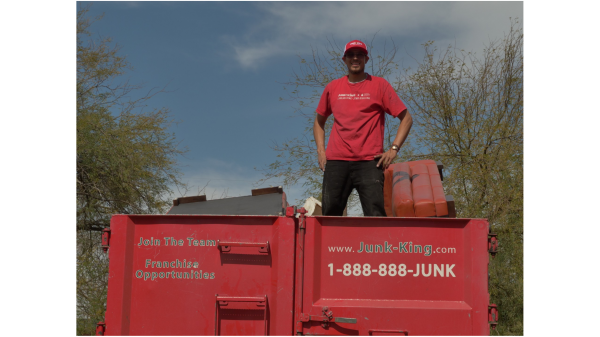
Tucson, United States, September 30, 2026 /NewsNetwork/ -- Junk King Tucson, the locally owned Junk King franchise serving Pima County, has expanded its yard debris removal and cleanup service in Oro Valley. The expansion extends same-day yard cleanup scheduling to Oro Valley households for the autumn season, giving homeowners a full-service option for clearing branches, brush, shrubs, leaves, wood piles, and other landscaping debris.

Further details about the company's yard debris removal services can be found at https://www.junk-king.com/locations/tucson

The expansion comes as Oro Valley homeowners begin fall yard work following the summer monsoon season, when storms can leave broken branches and brush behind. Crews from Junk King Tucson handle the lifting, loading, and cleanup, from a single pile of trimmings to a full property cleanup after a landscaping project.

Yard waste continues to be one of the largest categories of household discards nationally. According to the U.S. Environmental Protection Agency, Americans generated 35.4 million tons of yard trimmings in 2018, about 12 percent of all municipal solid waste. About 63 percent was composted or mulched, and landfills received roughly 10.5 million tons.

Regional waste goals point in the same direction. In neighboring Tucson, the city has set targets of 50 percent waste diversion by 2030 and zero waste by 2050, according to the city's Plan Tucson 2025. The 2025 plan also stresses the importance of recycling, with seven neighborhood recycling centers located throughout the city.

Junk King Tucson says it sorts collected loads for materials that can be donated, reused, or recycled where possible. Oro Valley residents can request an estimate on site, by phone, or by texting a photo of their debris. Pricing is based on the volume items occupy in the truck, and each truck holds up to 18 cubic yards, notes the company. The company's junk removal service covers almost anything, except hazardous waste.

"Oro Valley homeowners put a lot of work into their yards, and a fall cleanup or a landscaping project can leave behind more brush and wood than most people can haul themselves," said Marnie Prince, owner of Junk King Tucson. "Expanding our yard debris removal service in Oro Valley means residents can clear that material in one visit, and our team looks for ways to reuse or recycle what we can before anything goes to landfill disposal."

More information about junk removal services in Oro Valley is available at https://www.junk-king.com/locations/tucson/oro-valley.

About Junk King Tucson

Junk King Tucson provides residential and commercial junk removal, yard debris removal, and dumpster bag pickup throughout the Tucson area, including Oro Valley, Marana, Sahuarita, Green Valley, Vail, Rita Ranch, and the Catalina Foothills. The location is owned by Marnie Prince, who opened her first Junk King franchise in 2021 after a career in banking and finance.

In 2023, Franchise Business Review named Prince one of its Franchise Rock Stars, recognizing her as a top performer within the Junk King system. Junk King is part of Neighborly, a network of home and commercial service brands, and each Junk King location is independently owned and operated.

More information is available at https://www.junk-king.com/locations/tucson.

Contact Info:
Name: Marnie Prince
Email: Send Email
Organization: Junk King Tucson
Address: 3219 E 45th St, Tucson, AZ 85713, United States
Phone: +1-520-276-7756
Website: https://www.junk-king.com/locations/tucson

Source: NewsNetwork

Release ID: 89204877

In the event of any inaccuracies, problems, or queries arising from the content shared in this press release, we encourage you to notify us immediately at [email protected] (it is important to note that this email is the authorized channel for such matters, sending multiple emails to multiple addresses does not necessarily help expedite your request). Our diligent team will be readily available to respond and take swift action within 8 hours to rectify any identified issues or assist with removal requests. Ensuring the provision of high-quality and precise information is paramount to us.

More News

Why diesel prices are an economic time bomb

Sep 30, 2026

Why diesel prices are an economic time bomb

The price of diesel fuel is displayed outside of a Shell gas station in Carson, California, on September 22, 2026. | Patrick T. Fallon/AFP via Getty Images Everyone knows how much gasoline prices matter. The recent spike in gas prices triggered by the war with Iran has fueled deep pessimism about the economy and weighed heavily on President Donald Trump’s approval ratings. But diesel fuel — the lifeblood of shipping, agriculture, and heavy industry — usually flies under the radar. Its price has surged too, and while truckers and farmers are feeling the initial blow, the rest of the country won’t be far behind. “Most products in America are shipped along the road via trucks,” Nathan Bomey, a business reporter at Axios, told Today, Explained co-host Noel King. Diesel prices “directly affect their cost of doing business, which then eventually trickles down and affects the consumer.” On the podcast, Bomey discusses what’s driving the price spike, how quickly it’s going to become a problem for everyday consumers, and whether electric semi trucks could offer a way out. Below is an excerpt of the conversation, edited for length and clarity. There’s much more in the full podcast, so listen to Today, Explained wherever you get your podcasts, including Apple Podcasts, Pandora, and Spotify. What is happening with diesel? There was one major geopolitical event this year that disrupted the entire energy economy, which is the US and Israel attacking Iran. Iran is at the center of the oil economy in some ways, but primarily you have to look at the closure of the Strait of Hormuz and the jockeying over it that has happened in the months since. Once they closed the strait, it disrupted the entire global energy economy because it handles a substantial portion of the shipping bringing supplies out of the Middle East. That affected diesel prices, gasoline prices, jet fuel prices, and effectively everything based on crude oil. Who are the people right now that are profoundly freaked out about the cost of diesel? First off, truckers are freaked out because their cost of doing business is going much higher. Farmers are also freaked out because they’re already facing real pressures from trade wars and things that are out of control, like climate issues, that have caused their costs to go higher.  The price of diesel affecting farmers eventually affects the price they charge, which ultimately gets to the consumer because it ends up costing more to pay for things like an ear of corn. How stark do you think this might be? In a month or two, do you think I could go down to Walmart and see that something I buy all the time is now a dollar more expensive?  I think the impact is imminent. This flows through very quickly. We’re not talking about months; we’re talking about weeks, if not days, before people will start to notice increases, especially in the grocery aisle. That’s the first place people will notice it because fresh food has to be shipped on a weekly basis. Diesel prices are going to have a big effect on food inflation. This is coming off of several years of food price increases that we experienced in the wake of the pandemic. We’re also barreling toward the holiday shopping season, which is going to be affected by this as well. If a toy, for example, is made with a resin affected by the cost of crude oil, which also affects the cost of diesel, and then it’s shipped over the road to Walmart in a truck that uses diesel, all of these things add up and will probably lead to higher prices. We’ve also got an issue with heating oil, which is a fuel used primarily by households in the Northeast to heat their homes. Heating oil, diesel, and all of these oil-based products are caught up in this vortex right now. Ultimately, it is not something the ordinary person can do much about. Do the industries that rely on diesel have any other options? There are definitely alternatives to diesel, but in many cases, they cannot be switched to quickly. If you think about the trucking industry, they are invested heavily in big rigs that take products from place A to place B. If you are invested in a truck, yes, you could theoretically switch, but you would be scrapping this huge investment you’ve made. Diesel trucks are not really going anywhere immediately. A lot of times, they’re simply still the best way to get somewhere. You can switch to rail; railroads are definitely a competitor to trucking, but really only best for certain types of products. There are other types of trucks you can buy. Compressed natural gas or liquid natural gas is an alternative fuel for some trucks, and biodiesel can actually be good. Hydrogen is more of a futuristic thing down the road. In the short term, there is the possibility of using electric trucks. That is starting to become more realistic. In fact, in recent days, Tesla began major production of the Tesla Semi, an electric semitruck we’ve been waiting for for years. I remember covering this in 2018 when Tesla debuted the semi, and we all thought it was going to be coming out soon. It has taken nearly a decade for this to finally become a reality in large proportions, but the Tesla Semi is an electric truck that could be an alternative for some. There are other companies making electric trucks too, so that could be viable. But the problem with electric trucks is that the battery is so heavy, making it tough to compete with diesel on shipping heavy items. It was often joked that when the Tesla Semi first debuted, the very first thing it shipped was a bunch of bags of Cheetos because they were so light and the truck couldn’t handle extra weight. They had a deal with PepsiCo, and it wasn’t ready at the time to ship anything heavy.  It’s a lot better now, but the issue is still how heavy electric truck batteries are, which will make them somewhat limited in capacity. However, we are seeing some demand for the Tesla Semi that indicates it might become more competitive because of the price of diesel. So when prices are high, generally somebody somewhere is benefiting. Who is it, in this case? The people benefiting from diesel prices being so high are the refineries, which a lot of people don’t think about much because they’re the middle person in this entire process. They take the crude oil and turn it into usable diesel for a pickup truck, a semi truck, or farming equipment.  The refinery business is experiencing high demand right now, and there’s limited capacity to do this because of issues in Russia, Iran, and other places throughout the world. There’s really nowhere else to do this, and therefore they can charge higher prices. That means higher profits for the refineries. All of this is shaping up to potentially mean a really ugly winter. One thing I think about a lot is that American consumers will accept a lot of pain. We had Covid — the inflation, and shortages of literally everything. Then we had the war in Ukraine, and prices went up again.  People still keep spending money, even as we predict this one’s going to get bad. People go to the store and spend money, and maybe they gripe, but it’s not like we’re out in the streets. Do you think this coming diesel shock — imminent, in your words — is going to be different? I’m not an economist, but there is an interesting phenomenon emerging in the economy where consumer sentiment is at rock bottom, but consumer spending is actually really strong. There’s a gap emerging between what people say they feel and what they’re actually doing — in this case, they’re still spending.  Maybe it’s YOLO spending. They’re thinking they don’t have much going for them, so they’re just going to keep spending. I’ve experienced that a little bit, so I don’t blame anybody. At the end of the day, the numbers matter a little bit more than what people say they feel. But I do think people are going to hit a breaking point because they simply cannot continue this level of spending if the underlying fundamentals of the economy start to collapse.

YOUR NEWS, OUR NETWORK.

Do you have Great News you want to tell the world?

Be it updates about your business or your community, you can make sure that it’s heard by submitting your story to our network reaching hundreds of news sites across 6 verticals.

The Daily Feeder

A leading news network dedicated to keeping you up-to-date on the world's most important political, business, and cultural news into a three-minute read.

NEWSLETTER