
Custom Diamond Saw Blade for Granite Factory: Meeting Specific Industrial Requirements
Sep 26, 2026
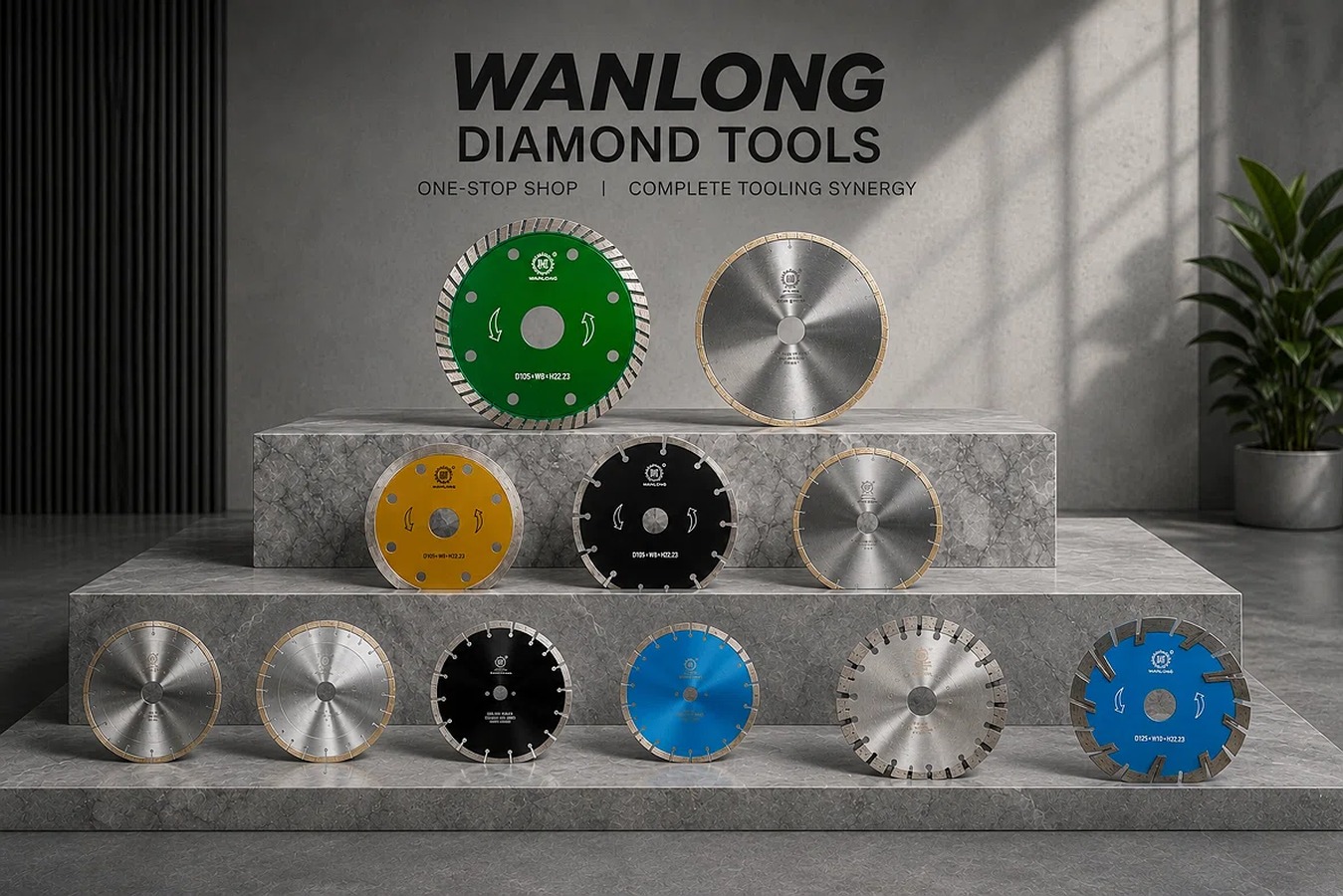
Quanzhou, Fujian Sep 25, 2026 (Issuewire.com) - Commercial granite cutting operations require precise synchronization between blade matrix metallurgy, spindle horsepower, and rock quartz concentration. Generic diamond tooling often suffers from accelerated segment wear on abrasive stones or segment glazing and blade fluttering on extra-hard quartzites, causing wavy cuts and excessive downtime. To address premature segment wear and maintain flat, high-speed sawing across diverse granite varieties, Fujian Wanlong Times Technology Co., Ltd. (WANLONG / Wanlong Group) manufactures high-performance custom diamond saw blade for granite tooling calibrated to specific mineral hardness and machinery parameters. Operating since 1993, WANLONG combines empirical rock laboratory testing, advanced powder metallurgy, and laser-welded alloy cores to deliver high-yield cutting solutions for global stone processing facilities.
Operating modern industrial facilities spanning 64 acres with 40,000 square meters of workshop capacity, WANLONG structures tooling customization around six core engineering criteria:
Dimensional Machinery Kinematics: Matching blade diameters from 105 mm to 2000 mm with specific spindle horsepower, flange mountings, and peripheral linear cutting speeds.
Engineered Segment Metallurgy: Formulating cobalt-based, iron-based, and bronze bond matrices calibrated to exact rock quartz content and Mohs hardness scales.
Alloy Core and Sintering Integrity: Utilizing 65Mn and 75Cr1 quenched steel cores with high-temperature hot isostatic pressing and high-strength laser welding interfaces.
Operational Cutting Environments: Designing water coolant distribution channels, noise-dampening sandwich silent cores, and specialized gullet profiles for wet processing.
Empirical Performance Testing: Verifying diamond retention strength, dynamic rotational balancing, and test cutting performance on reference granite varieties.
Standardized Technical Documentation: Supplying certified inspection certificates, material declarations, and international compliance documentation under European EN 13236 safety standards
Matching Blade Dimensions with Industrial Machinery Kinematics
Selecting the correct circular blade configuration requires precise alignment between machinery specifications, mounting interfaces, and daily production goals. WANLONG manufactures diamond saw blades spanning from 105 mm to 2000 mm in diameter to support diverse stone processing equipment. For manual saws, bridge cutting machines, and CNC saws, blades from 105 mm to 600 mm execute precision edge sizing and miter beveling. For multi-blade block cutters and primary sawing machinery, large-diameter blades up to 2000 mm slice heavy quarry blocks into dimensional slabs. Engineers calculate exact outer diameters, center bore dimensions, and pinhole patterns to match specific machine spindle designs.
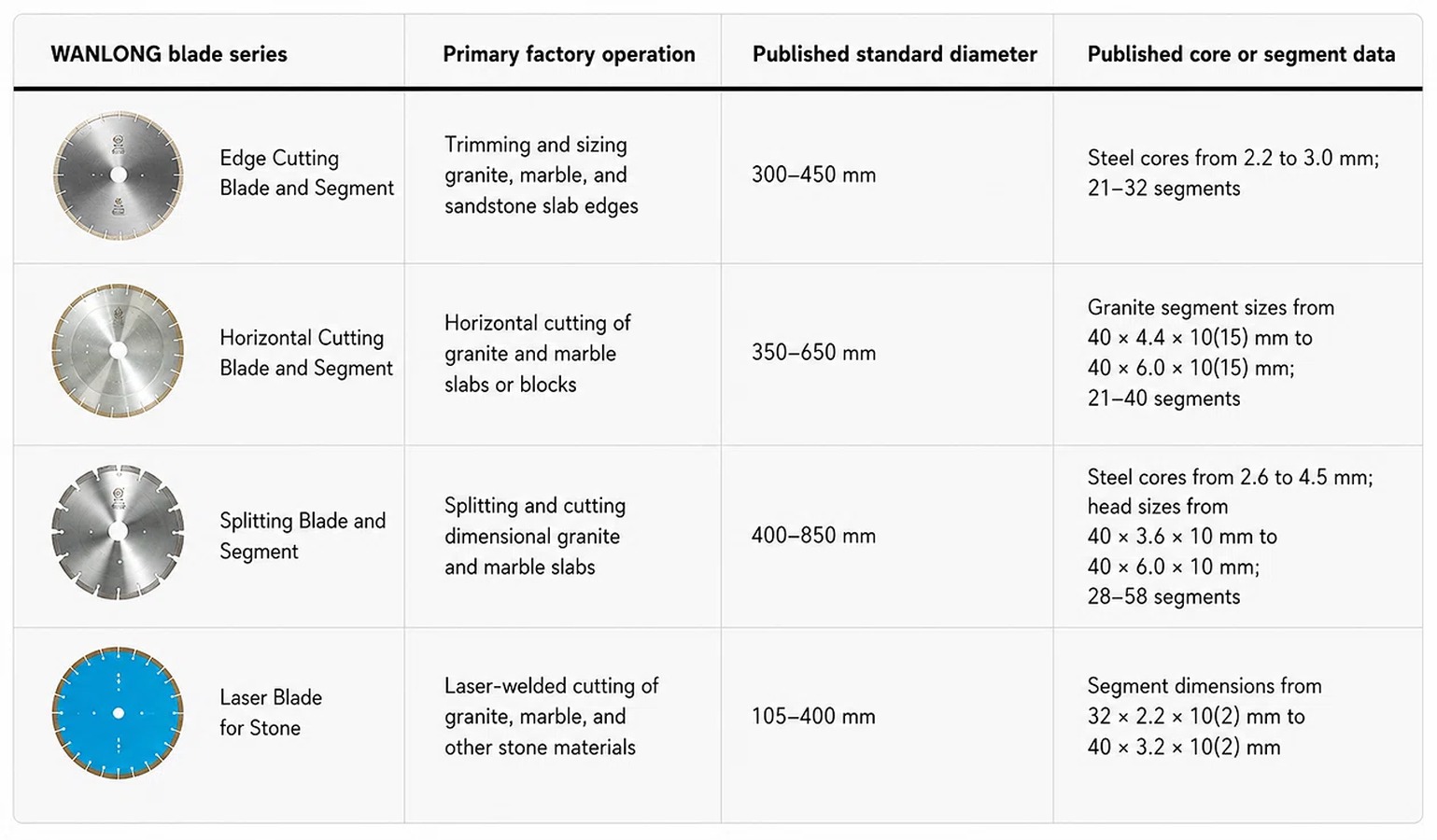
In industrial practice, selecting a custom blade requires determining the exact cutting station before finalizing core thickness and segment geometry. As illustrated in the representative tooling overview below, WANLONG structures primary workshop applications around dedicated, high-demand series:
Edge Cutting Blade and Segment (300-450 mm): Calibrated for precise slab trimming and edge sizing across granite, marble, and sandstone, utilizing stabilized 2.2 to 3.0 mm steel cores with 21-32 segment arrays to ensure chip-free borders.
Horizontal Cutting Blade and Segment (350-650 mm): Engineered for multi-directional block trimming and slab dividing, pairing reinforced segment profiles with flexible pitch layouts to balance cutting friction under continuous lateral feed.
Splitting Blade and Segment (400-850 mm): Built for high-load dimensional slab separation, featuring heavier core gauges (up to 4.5 mm) and high-density segment arrays to prevent blade deviation during deep single-pass cuts.
Laser Blade for Stone (105-400 mm): Utilizing direct beam-fused segment bonds for demanding dry or wet cutting, delivering exceptional thermal durability across compact fabrication hand tools and bridge cutters.
Beyond standard published diameters and segment dimensions, the engineering team formulates bespoke blade geometries, proprietary matrix bonds, and non-standard bore patterns tailored to unique machine dynamics.
Spindle power and rotational speed dictate the linear velocity of diamond cutting segments across the stone face. High-power block cutters operating at 132 kW require heavy-gauge steel cores with reinforced segment bases to handle intense rotational torque. Bridge saws running at variable speeds require optimized segment spacing to ensure smooth blade entry and uniform stone removal. Engineers align segment kerf thickness with steel core thickness to prevent side friction against kerf walls during deep multi-pass sawing. This kinematic alignment maintains stable blade trajectory and extends overall cutting life.
Segment Matrix and Diamond Formulation for Variable Granite Hardness
Granite mineral composition varies substantially across global quarries, ranging from medium-hard regional stones to extra-hard quartzites. WANLONG operates a specialized stone testing laboratory that evaluates mineral density, calcite content, and abrasive quartz percentages on client rock samples. Using empirical hardness data, metallurgists synthesize custom metal matrices that synchronize bond erosion rates with synthetic diamond crystal wear. For hard, high-quartz granites, cobalt-rich and bronze matrices expose sharp diamond cutting points continuously to prevent segment glazing. For highly abrasive, softer granites, tungsten carbide and refractory additives reinforce the metal matrix against rapid slurry erosion.
Synthetic diamond grain selection determines the micro-fracturing characteristics and impact resistance of cutting segments. WANLONG selects high-grade octahedron diamond crystals featuring exceptional thermal stability and elevated Thermal Toughness Index (TTI) ratings. Diamond crystals receive chemical active alloy coatings, such as titanium-silicon or nickel-chromium, to establish strong metallurgical bonds during sintering. Automated cold-press molding systems distribute metal powders and coated diamond grits with tight weight tolerances of plus or minus 0.1 grams per segment. Subsequent Hot Isostatic Pressing (HIP) consolidates segments to full density, eliminating internal porosity and ensuring consistent cutting speed.
Steel Core Dynamics, Welding Integrity, and Precision Manufacturing
The structural steel core provides the mechanical foundation that keeps the circular blade running true under heavy industrial cutting loads. WANLONG utilizes premium 65Mn and 75Cr1 alloy spring steel plates that undergo precise heat treatment and quenching processes. Experienced technicians perform disciplined mechanical rolling and tension leveling to establish uniform radial and tangential tension throughout the core. This balanced tension profile eliminates blade fluttering and side deflection during high-speed rotation. Dynamic balance testing and laser surface inspection confirm radial and axial runout within tight tolerances of 0.05 mm.
Segment attachment integrity is critical for industrial workshop safety and consistent cutting performance. WANLONG utilizes automated high-frequency silver brazing and high-penetration fiber laser welding systems to bond segments securely to the steel core. For high-intensity fabrication lines and demanding stone materials, fully laser-welded blades eliminate segment loss under continuous thermal stress, providing maximum operational safety. Every welded segment undergoes rigorous torque testing and mechanical pull-off verification compliant with EN 13236 safety standards. This high-strength joint structure withstands intense thermal shocks and heavy dynamic impacts during continuous granite processing.
Tailored Engineering for Specific Industrial Processing Conditions
Industrial stone processing facilities often operate under unique workshop constraints, environmental regulations, and production targets. WANLONG customizes blade core architectures to satisfy specialized operational requirements across global processing plants. For urban fabrication shops subject to strict noise restrictions, sandwich silent cores incorporating copper sound-dampening layers reduce operational noise by 10 to 15 decibels. Specialized keyhole, wide-U, and fishhook gullet designs accelerate coolant water flow and flush abrasive stone sludge rapidly from deep cutting kerfs. These optimized water channels preserve thermal balance and maintain sharp diamond cutting points during long production shifts.
Tooling customization also adapts segment geometry to specific material behavior and cutting kinematics. For instance, horizontal cutting blades and slab-splitting tools require optimized segment widths and clearance angles tailored to hard granite rather than softer stones to minimize lateral friction and maintain strict slab verticality. Both silent and standard solid steel cores can be integrated across these operational blade types.
For multi-blade block cutting operations, WANLONG provides synchronized multi-blade sets manufactured with matched thickness tolerances. Engineers calculate progressive blade diameter steps and uniform segment kerfs across sets of up to 26 blades mounted on a single spindle. This synchronized multi-blade configuration distributes cutting loads evenly, producing flat dimensional slabs with minimal surface thickness variation. Stone fabricators benefit from reduced grinding requirements on downstream automated polishing lines, accelerating overall workshop throughput.
Quality Verification, Empirical Testing, and Scalable Mass Production
WANLONG enforces rigorous quality governance across all manufacturing stages under the SGS ISO 9001:2015 quality management system. Before initiating large-scale batch manufacturing, the enterprise produces pilot test blades for empirical verification on reference stone varieties. Laboratory technicians analyze actual square meter output, cutting speed in meters per minute, and segment wear rates per square meter. Based on empirical test cutting feedback, metallurgists fine-tune diamond concentration and binder hardness to achieve optimal tooling economy. Once validated, automated production lines replicate exact metallurgical formulas across multi-ton production batches with complete repeatability.
All finished diamond saw blades receive detailed quality inspection certificates and standardized Declarations of Conformity (DoC). Compliance protocols under European EN 13236 standards validate tool safety and operational limits for international trade. Operating 40,000 square meters of heavy production facilities, WANLONG maintains scalable manufacturing capacity to fulfill large wholesale container orders reliably. Protective wooden crating and anti-corrosion packaging preserve blade integrity during international maritime transportation to global stone processing hubs.
Commercial Advantages and Strategic Value of Custom Tooling Solutions
Investing in customized diamond saw blades delivers decisive operational and economic advantages to high-volume granite processing enterprises. Direct factory collaboration eliminates distributor markups, providing favorable procurement pricing for industrial-scale tooling programs. Matched diamond segment formulas accelerate cutting speeds, reduce electrical power consumption, and lower tooling cost per square meter of processed stone. Precision-tensioned steel cores produce smooth, uniform slab surfaces that minimize raw material waste and reduce downstream surface finishing labor. These operational gains enable stone processing plants to expand production capacity, shorten order turnaround times, and strengthen market competitiveness.
To submit stone samples for laboratory analysis or download technical blade catalogs, visit the official portal at https://www.wanlongtimes.com/ . Direct engineering consultations and wholesale container quotations are available through the official international portal.
Media Contact
Wanlong Times Technology Co., Ltd.
0086 595 2249 8030
13# Zhitai Road Quanzhou Economic Technology Development Zone, Quanzhou, China
Source :Wanlong Times Technology Co., Ltd.
This article was originally published by IssueWire. Read the original article here.
More News











Recommended










YOUR NEWS, OUR NETWORK.
Do you have Great News you want to tell the world?
Be it updates about your business or your community, you can make sure that it’s heard by submitting your story to our network reaching hundreds of news sites across 6 verticals.