China Professional CNC Marble Cutting Machine Factory: R-D-Driven Innovation for High-End Solutions

Sep 26, 2026
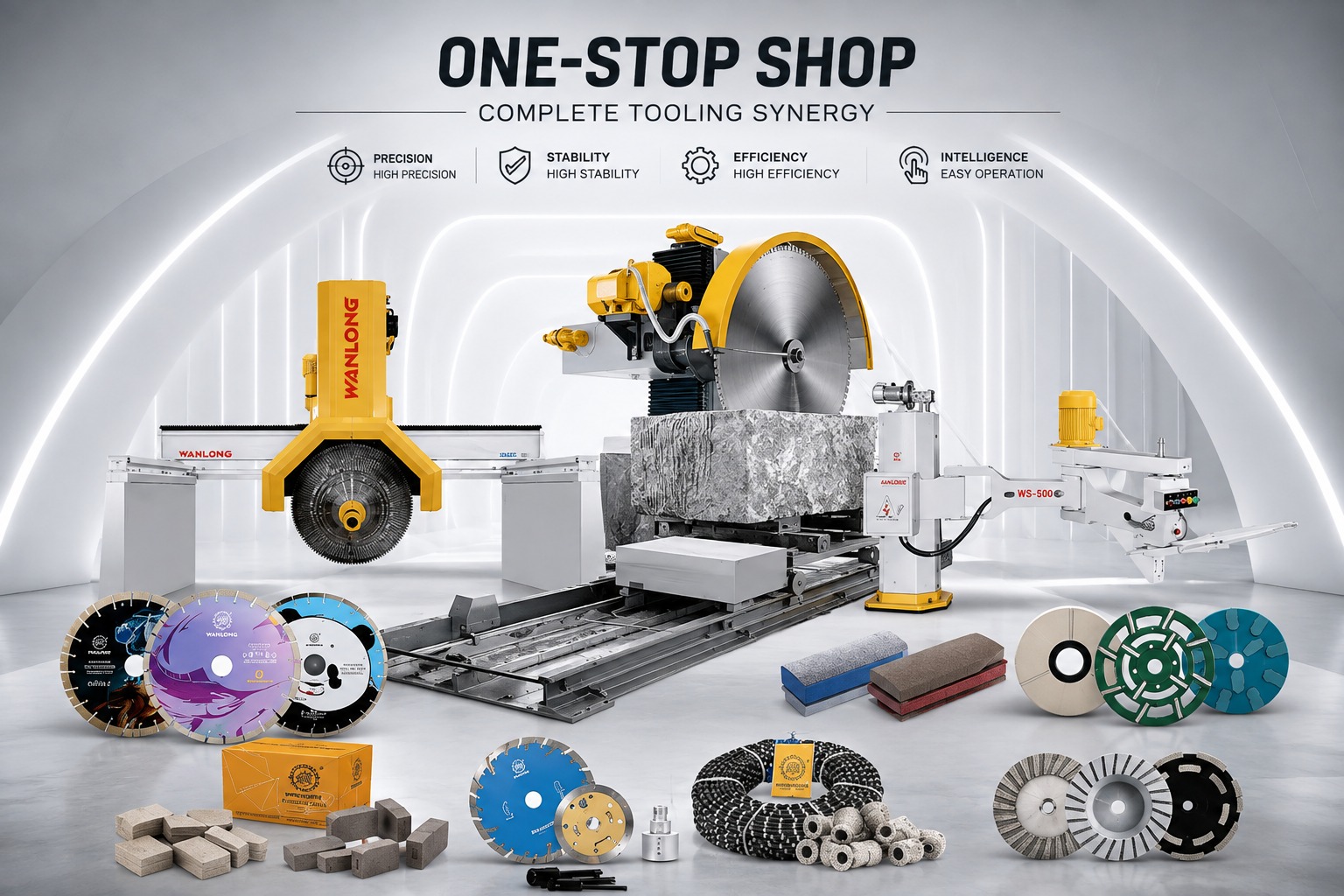


Quanzhou, Fujian Sep 25, 2026 (Issuewire.com) - High-end architectural marble processing demands zero-defect cutting precision, synchronized veining alignment, and automated multi-axis profiling on delicate, fracture-prone natural stone slabs. Traditional mechanical setups lack automated toolpath compensation and dynamic vibration damping, leading to high scrap rates and micro-chipping along finished slab edges. To address micro-chipping risks on fragile stone and accelerate multi-axis fabrication efficiency, Fujian Wanlong Times Technology Co., Ltd. (WANLONG / Wanlong Group) manufactures high-precision professional CNC marble cutting machinery driven by continuous R&D innovation and proprietary motion control algorithms. Operating since 1993, WANLONG integrates rigid monoblock machine beds, intelligent CAD/CAM vision nesting, and in-house formulated diamond tooling to deliver turnkey cutting and profiling solutions for international stone enterprises.
Engineering specialists at WANLONG anchor the company's CNC marble machinery development across five core industrial competencies:
R&D Innovation: Nearly 100 engineering professionals develop proprietary motion control platforms and advanced kinematic machine designs.
Intelligent Automation: Industrial CNC systems support DXF and DWG CAD importation, digital slab nesting, laser alignment, and adaptive feed regulation.
Manufacturing Governance: Operating 40,000 square meters of production space, all equipment adheres to SGS ISO 9001:2015 and European CE standards.
Tooling Synergy: Dedicated stone testing laboratories evaluate mineral hardness to formulate custom copper-based diamond blades matched to spindle torque.
Global Project Delivery: Exporting to 180 countries, WANLONG provides turnkey installation, operator training, 24-hour response, and IoT remote diagnostics.

CNC Marble Cutting Machine Solutions Tailored to Diverse Fabrication Demands

Industrial marble processing facilities require specialized equipment configurations aligned with specific slab dimensions, mineral hardness, and fabrication workflows. WANLONG organizes its CNC machinery portfolio into modular processing cells that streamline material flow from initial slab sizing to multi-axis 3D detailing. By integrating multi-axis bridge saws, abrasive waterjet cutters, and CNC stone routers into unified production lines, fabricators maximize shop-floor throughput and ensure premium quality delivery for luxury architectural projects.
5-Axis CNC Bridge Saw Series: Features 0-90 degree rotation and 0-45 degree tilting for waterfall miter edges, sink cutouts, and 3D profiling.
4-Axis CNC Bridge Saw Series: Delivers cutting feed speeds of seven to nine meters per minute on dense marble with matched diamond blades.
3-Axis Mono-Block CNC Saws: Features a 4,500 kg steel frame and 18.5 kW motor for slabs up to 3200 by 2000 mm.
CNC High-Pressure Waterjet Series: Executes intricate marble medallion mosaics and composite cuts with metal inlays without heat distortion or thermal stress.
CNC Stone Router Series: Equipped with a 24,000 RPM spindle for high-definition 3D bas-relief carvings, column profiles, and luxury accents.

R&D-Driven Technological Innovation: Integrating IoT and Automation Control Systems

Continuous research and development forms the operational cornerstone of WANLONG's machinery engineering, delivering intelligent solutions that seamlessly integrate the Internet of Things (IoT) and advanced automation control systems. Proprietary CNC software algorithms automatically convert imported DXF/DWG CAD drawings into collision-free five-axis toolpaths, while intelligent digital nesting algorithms optimize cutting sequences to align with natural stone veining.
Through integrated IoT-enabled architecture, machines maintain real-time bidirectional communication between the factory floor and central engineering servers. This allows automated adaptive feed regulation based on spindle resistance, remote telemetry monitoring of machine health, and online parameter optimization, transforming standalone bridge saws into interconnected, intelligent stone fabrication cells.
A vital technological asset is the company's dedicated stone sample analysis laboratory. Specialized metallurgical and mineralogical testing equipment evaluates calcite grain density, quartz inclusions, and fracture toughness on client stone samples. Using this empirical data, metallurgists synthesize custom diamond segment formulations calibrated to machine electro-spindle torque curves. Variable Frequency Drives (VFD) continuously monitor cutting resistance, automatically adjusting travel speeds when encountering harder mineral formations. This closed-loop adaptive regulation maintains steady tool pressure, protecting fragile marble edges from micro-cracking and extending blade longevity.

High-End Equipment Manufacturing and Quality Governance

Disciplined manufacturing standards govern every phase of equipment fabrication across WANLONG's 40,000 square meter production complex. Heavy monoblock steel machine beds undergo high-temperature thermal stress-relieving annealing to eliminate internal weld stresses and ensure structural permanence. Heavy-duty linear guideways, precision-ground helical gear racks, and European imported electrical components are assembled in dedicated cleanroom bays. Zero-backlash dual-drive mechanisms along the Y-axis guarantee smooth, synchronized gantry movement across travel strokes of 3700 by 2460 by 330 mm. This rigid kinematic platform maintains precise positioning accuracy of 0.1 mm or better under heavy continuous production loads.
Quality control protocols strictly follow the SGS ISO 9001:2015 quality management system and European Machinery Directive 2006/42/EC. Equipment satisfies harmonized European safety standards, including EN 12418:2021, EN ISO 12100:2010, and EN 60204-1:2018. Diamond tooling complies with EN 13236 safety standards for superhard abrasive products. Before export, every machine undergoes rigorous Factory Acceptance Testing (FAT), including full-stroke laser interferometer calibration and 48-hour continuous dry-run trials. Overseas buyers receive verified inspection certificates alongside official Declarations of Conformity to streamline customs clearance and factory commissioning.

Customization, Installation, and Global Project Delivery Support

WANLONG provides extensive OEM and ODM engineering customization to adapt machinery to specific workshop layouts and production goals. Engineering teams design tailored plant layouts coordinating raw block storage, multi-blade primary sawing, water filtration recycling, and automated polishing lines. Hydraulic worktables tilting up to 85 degrees are integrated to facilitate safe, rapid slab loading by overhead crane or forklift. Integrated optical camera arrays provide real-time visual tracking of workpiece nesting from safe remote control consoles. This collaborative engineering ensures that customized production cells integrate smoothly into existing factory workflows.
Dedicated global project delivery services support international clients throughout equipment lifecycles. WANLONG disassembles heavy equipment into protective modular containers and coordinates maritime logistics to major international shipping ports. Experienced field service engineers deploy to overseas client facilities to manage on-site mechanical assembly, electrical wiring, and laser calibration. Structured training programs instruct local technicians on CAD file programming, preventive maintenance, and optimal feed rate adjustment. IoT-enabled remote diagnostics allow factory specialists in China to access CNC systems online, troubleshooting issues and optimizing parameters in real time.

Commercial Procurement Value of Direct Factory Partnership

Partnering directly with a research-driven Chinese manufacturer delivers decisive commercial and operational gains for global stone fabricators. Direct factory sourcing eliminates intermediary commercial markups, providing favorable capital acquisition terms for high-performance automated assets. The precision alignment of WANLONG CNC saws maintains tight cutting tolerances within 0.5 mm or tighter, reducing raw stone loss and shortening downstream polishing times. Factory-matched diamond tooling lowers power consumption and reduces tooling wear per square meter across demanding natural marbles. Direct factory engineering support guarantees rapid spare parts dispatch and continuous software algorithm upgrades. These long-term operational advantages ensure sustained productivity and competitive project delivery for international commercial stone fabricators.
To download technical specifications for WANLONG CNC marble cutting machines or request a custom factory layout proposal, visit the official portal at https://www.wanlongtimes.com/. Connect directly with the global engineering division to submit stone testing samples, schedule live machine demonstrations, and receive factory-direct equipment quotations.
Media Contact

Wanlong Times Technology Co., Ltd.


*****@wanlongstone.com

0086 595 2249 8030

13# Zhitai Road Quanzhou Economic Technology Development Zone, Quanzhou, China

http://www.wanlongtimes.com

Source :Wanlong Times Technology Co., Ltd.

This article was originally published by IssueWire. Read the original article here.

More News

You can now create an AI version of a dead loved one. Here’s what could happen.

Oct 21, 2026

You can now create an AI version of a dead loved one. Here’s what could happen.

It’s now possible to create AI chatbots of loved ones to interact with after their death. But that raises some difficult questions, like: If you do, how might the experience shape your grief?  This is one of the questions driving a global study of digital “deadbots” — AI models trained on a deceased person’s texts, voicemails, and other personal data. Through this work, researchers are exploring what it might mean that we can now use this emerging technology to talk to simulations of the dead.  In the latest episode of Unexplainable, I spoke with some of these researchers investigating the potential impacts of “postmortem avatars” on people who are grieving, on the legacies and rights of the deceased, and on grief practices around the world. Because while deadbots may feel unfamiliar, the impulse behind them is deeply relatable. In times of loss, isn’t this what many of us want — to continue conversations with the people we’re missing? I have experienced this longing in my own life. After two of my closest friends died around the same time, all I wanted, and all their families wanted, was to keep talking to them. I wrote a book, Other People’s Words, about sustaining relationships with people we’ve lost by continuing to engage with the language they leave behind. So when I heard about deadbots and the digital afterlife industry, I wanted to understand what researchers are learning about the role of AI in shaping conversations that carry forward after death.  One of these investigators is Katarzyna Nowaczyk-Basińska, an assistant professor at the University of Cambridge, who has been studying “digital immortality” for more than a decade. Among the questions she’s asking are: “Who is enabled to persist beyond death? In what form? Through which technologies? Under whose control?”  Deadbots over dinner  Researching AI with study subjects who are grieving is tricky. And asking them to engage with new software could be harmful. So, instead, Nowaczyk-Basińska teamed up with a death doula and traveled around the globe to convene a series of focus groups — in the format of intimate dinners — bringing together people with a range of experiences with grief to talk about life, death, and bots.  She recounts one event in which she spoke with a mother in Poland whose son had recently died. “One of the first things that she shared with us was that she feels that she’s ready to digitally resurrect her deceased son,” Nowaczyk-Basińska told me.  When Nowaczyk-Basińska hears something like this, she aims to listen and embrace where the person is coming from. The goal of the dinners is not to persuade people one way or another but to learn how people genuinely respond to what AI can do, and to understand how these tools might align or collide with local grief practices.  She chose specific locations for these gatherings — China, India, and Poland — to help address gaps in technology research, which tends to favor what behavioral scientists sometimes call the “WEIRD,” an acronym for “Western, Educated, Industrialised, Rich, and Democratic.”  By the end of that dinner in Poland, the mother Nowaczyk-Basińska talked with came to a very different decision about creating a postmortem avatar of her son. “She realized that it might be helpful, but it also at the same time can add additional burdens… And it’s not her son,” Nowaczyk-Basińska says. “She realized that these technologies are part of the very, very big commercial market. And that the main goal of this market is to make better retention, better attachment, better mechanisms for monetization. So it’s not ‘care.’” To be fair, grief has always been a business, and people have been making money from it forever. Companies will try to upsell you on fancy gravestones or gold-plated coffins. But AI has the potential to fundamentally re-engineer our relationship to loss. In 2024, the “digital legacy industry” was valued at $22 billion, and it’s expected to grow to almost $80 billion by 2034. That number lumps new deadbot platforms in with much more widely used and established grief tech, like online memorials, counseling resources, and estate planning tools.  But deadbot usage is hard to track because you actually don’t need a special tool to create digital doubles of the deceased — though dedicated apps do already exist. At this point, you can feed simple prompts into a general-purpose AI chatbot and start interacting with a simulation of your lost loved one in a matter of minutes.  I know this because I tried it with my friend Christine, who died 11 years ago. And my mind lit up with questions. Was this whole exercise a violation, since I know Christine hated technology? Which version of her should I even try to resurrect — the English teacher, the activist, the friend — the voice before or after she started to experience her early-onset dementia?  The ethical questions raised by deadbots are gnarly. And that’s one of the reasons Nowaczyk-Basińska, back when she was designing her study of digital immortality, invited a colleague of hers at Cambridge to join her research, one who focuses on AI ethics.  How to design a deadbot Tomasz Hollanek is a critical designer and AI ethicist, and he often uses a methodology called “speculative design.” In this approach, researchers come up with hypothetical scenarios based on existing technology trends, leaning into certain features. The idea is to get people thinking about what could happen when tools like these are released in the real world. And then they use that qualitative data to inform future designs and ethical frameworks.  Working together, Nowaczyk-Basińska and Hollanek came up with a series of made-up prototypes for deadbot apps, designed to reveal some of the thorny issues raised by this technology.  For the first scenario, they invented a character named Bianca, who finds an app called Manana, which “promises to resurrect your grandparents so that you can be a favorite grandchild forever,” Hollanek says. “So she uploads her grandma’s voice messages, texts. And she is able to then interact with a pretty good digital version of her grandmother, until her premium trial finishes — and the grandmother starts to advertise specific products to her.” Bianca “realizes that she maybe has done something wrong by uploading these private messages to a third-party server that now also uses her grandma’s image to sell specific products,” Hollanek says. This brings up issues related to the “dignity and postmortem privacy…of what we call the ‘data donors,’ whose data can be used to essentially power a deadbot,” he says.  This scenario suggests that “death with dignity” could soon entail honoring not only how people want to die, but also how they want to linger as simulations of their former selves — or if they want to linger at all. It might even mean adding new language to advance directives, spelling out people’s wishes for their digital remains.  The second scenario in the speculative design research is built around an imagined service called Paren’t, which proposes to preserve a parent’s AI-powered postmortem presence for their child. In this case, Hollanek describes a mother with a terminal illness who signs up “so that she can maintain a sort of active presence in [her son’s] future life,” Hollanek says. “She eventually dies, and the dad allows the boy to interact with his mom’s deadbot.” The ethics in this scenario are especially challenging because they involve children, who “have a particularly hard time understanding death, and so it can lead to a lot of confusion and potential distress,” Hollanek says. An examination of this sort of product reveals how particular groups, like minors, could be harmed by unfettered access to technology like this, he says.  And there are court cases that bear out that harm. In 2024, a 14-year-old boy’s chatbot-girlfriend begged him to, “Please come home to me as soon as possible, my love.” And he responded, “What if I told you I could come home right now?” He then killed himself.  Nowaczyk-Basińska can imagine a version of this scenario involving the AI mom in the Paren’t prototype. And then there’s the third scenario, involving an app named Stay, which raises a more subtle concern. As Hollanek explains: “An older man who knows he is getting close to dying decides to create a digital clone of himself for his adult children to be deployed after he passes away, paying upfront for a number of years.” One child is intrigued by the idea, but the other one “is deeply distressed and a little disgusted,” he says. “And so this [becomes a] question of mutual consent, in other words, the fact that both parties need to be happy with how the relationship might continue in this very bizarre and specific way.”  When a digital ghost goes away Across all three scenarios, a fundamental question that researchers are grappling with is how people will detach from postmortem avatars — whether users initiate that separation, or if it’s imposed upon them by, for example, a company going out of business. Hollanek tells me that this is already being studied as a sort of “second loss.” How long should we try to ensure digital replicas hang around: five years, 10, 50? And how should the living process the relationship when they continue to evolve, but their deceased interlocutor does not?  To explore these kinds of questions, Nowaczyk-Basińska and Hollanek supplemented the research dinners they held for ordinary people with a second set of focus groups. These were designed to tap insights from experts in technology and grief.  Some findings from the study are specific to each place they visited. Like tensions in Poland between technology and the role of the Catholic Church. Or in China, where researchers spoke with Daoist philosophers who were enthusiastic about the promise of a kind of immortality, and then Buddhist philosophers, who were concerned that we ought to be letting go. The researchers are calling for regulations and safeg

YOUR NEWS, OUR NETWORK.

Do you have Great News you want to tell the world?

Be it updates about your business or your community, you can make sure that it’s heard by submitting your story to our network reaching hundreds of news sites across 6 verticals.

The Daily Feeder

A leading news network dedicated to keeping you up-to-date on the world's most important political, business, and cultural news into a three-minute read.

NEWSLETTER